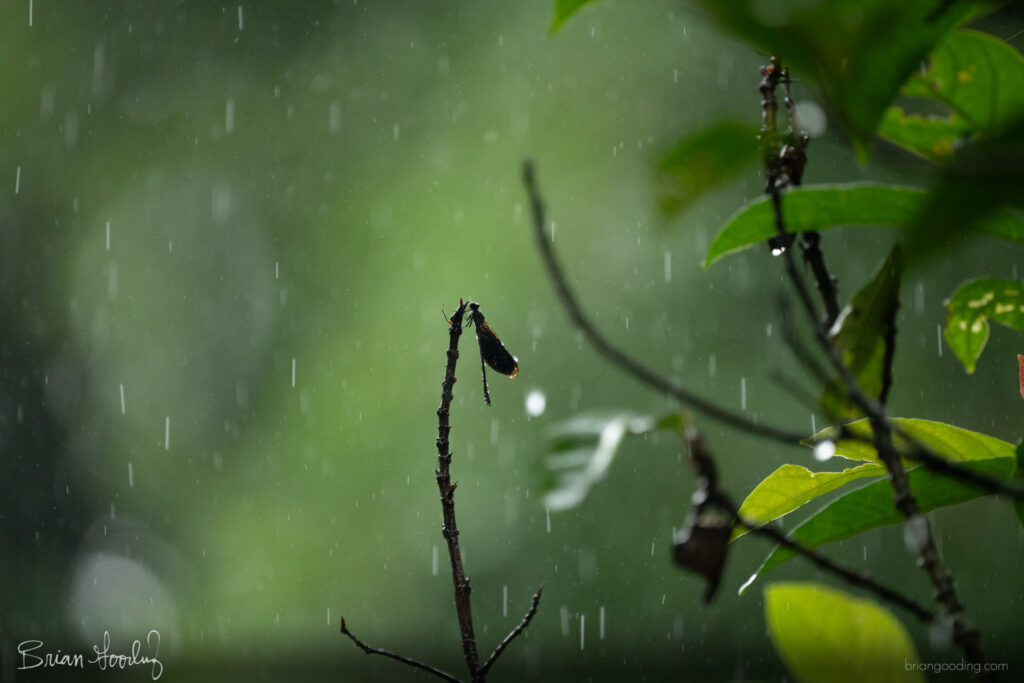
Last year when I was really in a good place I started a series of essays on creativity, personal workflow and process, and viewing life in a detached manner, primarily as data. At that time I was in a positive rhythm and really zooming out and looking at my photographic creative output over the past few decades. A few things were striking to me even though I intuitively knew them.
I’m writing this now because I’m posting a project that began during that time, revolving around the dragonflies I photographed throughout Thailand, Vietnam, and Taiwan. The project demonstrates a level of technicality and precision that nearly goes in opposition to most of the work I have been doing lately with street photography.
In some ways I think I need to rebalance–I’ve primarily been in massive cities for the past few months, split between Bangkok and Saigon. Both of these places are like home to me even though I’m still a stranger. And the mountains will be the same. But looking through the dragonfly photos in the above gallery I feel the sense of stillness and calm which that type of work requires, not the frenetic street energy of life here, embodied in the photographic work I’ve done lately.
Below is some of the analysis. Be careful…this quickly becomes philosophical.
Venn diagram / 10.24.25 12:55
overview
I have been thinking a lot about the types of photography I have been working on during this trip (and on a larger scale, over more than two decades). The majority of the work can be divided into insect photography (primarily dragonfly) and street photography (mainly people in dense urban environments).
I have been fortunate enough to do both types of photography in many places throughout the world (through luck, risk, and constant improvisation…). Some big locations for insects for me have been in rural and jungle areas in China, Costa Rica, Taiwan, Thailand, Vietnam. Though different micro-locations, cities in those countries such as Shanghai, San Jose, Taipei, Bangkok, and Saigon have been huge playgrounds for me for street photography.
There is some major overlap and also some dichotomous characteristics between the two main styles I focus on–insect photography and street photography.
differences
insect photography
I was initially thinking of how opposite my approach is between the two styles–when photographing insects, usually I am completely still, often sitting or standing in the same place for extended periods of time, and precision measured in less than millimeters is important. The compositions are typically very sparse and minimalistic, with one identifiable subject. When taking photos of insects I use a tripod and almost always shoot with a 300mm lens, which makes isolating a subject more simple than with a wider lens (I use a 35mm for street photography). I carry significantly more equipment shooting insects but when taking photos of people I have minimal equipment to be as unobtrusive as possible.
street photography
My philosophy for street photography is extremely different than with insects and when I thought about it more I was a little shocked. For street photography my mode of operation is literally to never stop moving–I do not even stop for subjects (though I occasionally pivot, but still stay in some kind of natural motion). Often when shooting here in Saigon or Bangkok…anywhere actually…I do not even look while shooting. I am constantly trying to refine my sense of proprioception and balance the angle of the lens to subjects while maintaining a relatively natural posture. The entire process is more based on intuition and a gestalt cohesion of composition. Highly dynamic images and hyper-dimensionality are more common than any sense of tranquility or simplicity.
breakdown of differences
- subject identifiability (readily identifiable vs. multiple/absent)
- complexity of composition (simple vs. complex)
- physical environment (isolated vs. dense)
- physical approach (still vs. motion)
- equipment (type of equipment, field of view)
similarities
My goal in both types of shooting is to have no interaction with the subjects, for it to be purely observational. In practice I generally achieve this, though often with higher success in street photography (due to the sensitivity of insects, as well as not typically being a natural part of the environment I seek them out in (ie: jungle)). With insects there is no possible pretense so it is not an issue, but with humans the importance of the image being candid is more mundanely journalistic and anthropological than about novelty of expression.
Despite having extremely different approaches, one way I gauge success is exactly the same–it is not the related to the quality of the image, but the reason I even take photos. Over many years the process as become the primary motive for taking photos, not the images themselves. In a way they are symbiotic in motivating each other, but without the meditative process…I don’t think I would continue.
breakdown of similarities
- flow as process
- philosophical approach (non-interaction as goal)
- equipment (simplicity of equipment)
- thematic
insect – behavior, morphology, anomalies
street – archetype, cultural processes, character of city/environment- iterative angles (lateral, frontal, oblique)
Re-reading this, which was written about a year ago, I see how embedded this concept is even in my musical work–particularly in terms of composition, theme/subject identifiability (ambient vs. melodic), and impetus for creation. Though I primarily write sparse cinematic audio I do write in other styles that are much more…saturated with activity (such as “nominal”, a song attached to this post below the image).
This didn’t even cross my mind last year, but at that time I had taken a hiatus from the writing monthly albums. I guess the most interesting thing for me is this drive to create and seek flow in these activities is constantly manifest through work that comes out as near-minimalism and near-overstimulation.
Okay, this went on long enough. I initially just intended to introduce The Odonata of Thailand, Vietnam, and Taiwan…but got sidetracked. This isn’t really a clean wrap-up, but I need to go eat.